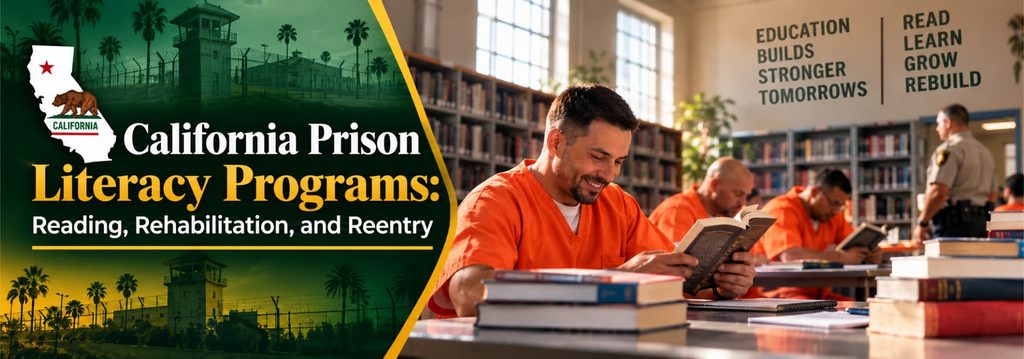
California prison literacy programs help incarcerated learners develop reading skills and work toward educational goals. Books give students material to practice with, explore, and return to as their confidence and interests grow.
For families, supporting literacy begins with choosing reading that fits the person. A useful dictionary, an accessible novel, or a requested study guide can complement the learning opportunities available inside a facility.
California prison literacy programs combine skill-building with opportunities to use those skills. Understanding the available services can help families choose reading that complements the learner’s progress.
What California Prison Literacy Programs Include
CDCR’s education and library services offer several routes into reading and learning.
Adult Basic and Secondary Education
CDCR Adult Education includes Adult Basic Education, or ABE, and Adult Secondary Education, or ASE.
ABE serves beginning readers and English learners reading below the ninth-grade level. ASE supports learners at ninth-grade reading level or above as they work toward a high school diploma or equivalency. Placement depends on assessed reading level.
For California prison literacy programs, matching instruction and reading materials to the learner’s current skills is an important starting point.
Peer Literacy Mentoring
The Peer Literacy Mentor Program provides tutoring support for incarcerated learners who lack a high school diploma or equivalency. Literacy teachers train mentors to assist students with their educational needs.
This adds individual support to California prison literacy programs, helping learners work through material with guidance.
Libraries and Reading Activities
CDCR Library Services provides fiction, nonfiction, reference works, and basic literacy materials. Libraries also carry resources about employment, community reentry, and life skills. Activities may include book clubs or study groups.
CDCR lists adult education and library services at all its institutions. Specific access, assignments, schedules, and activities should be checked locally.
How Does Reading Help Incarcerated Individuals Rehabilitate?
California prison literacy programs connect reading practice with useful learning tasks. A student can practice identifying a paragraph’s main idea, understanding unfamiliar words, following written instructions, or summarizing information. These activities give reading a practical purpose.
Fiction can provide material for exploring characters, decisions, and consequences. Biographies introduce different life experiences. Educational books provide explanations and exercises tied to a subject the reader wants to study.
Reading and rehabilitation for inmates can therefore connect through purposeful practice, reflection, and continued education. The reader’s interests and starting skills should guide the selection.
What Impact Does Literacy Have on Recidivism Rates in California?
California’s published evidence supports an association between academic achievement and lower reconviction rates. It does not provide a single percentage attributable to literacy instruction alone.
In CDCR’s supplemental report for people released in fiscal year 2020–21, the three-year conviction rates were:
| Academic achievement during incarceration | Three-year conviction rate |
|---|---|
| Earned an academic educational achievement | 22.4% |
| Did not earn an academic educational achievement | 40.5% |
The difference was 18.1 percentage points. The academic category included achievements such as high school equivalency, diplomas, and college degrees. These are observed group differences. They do not establish that reading alone caused the difference or that every participant in California prison literacy programs will have the same outcome.
CDCR’s primary recidivism measure is a three-year conviction rate. Arrests and returns to prison are separate measures, so they should not be used interchangeably.
Do Books Reduce Recidivism?
Books supply material for literacy practice and education. Research supports correctional education more broadly, while the effect of receiving a particular book is not isolated in the studies cited here.
A 2018 national meta-analysis, summarized by RAND, found that participants in correctional education were 28% less likely to recidivate in the studies with the strongest research designs. That finding concerns correctional education programs across the United States, rather than a California-only literacy or book-delivery intervention.
The practical lesson for California prison literacy programs is to connect access to books with suitable instruction, practice, and educational goals.
California Prison Literacy Programs and Reentry Preparation
California prison literacy programs can support learning that remains useful after release.
Consider reading materials that let learners practice:
- Understanding workplace vocabulary and written directions.
- Reading educational or training materials.
- Finding information in a reference book.
- Comparing explanations and identifying key facts.
- Understanding practical subjects such as personal finance or everyday mathematics.
CDCR libraries specifically include employment, reentry, and life-skills resources. Families can complement those collections with requested titles appropriate to the learner’s needs.
Choosing Books to Support California Prison Literacy Programs
Start with the person’s interests and any guidance from their teacher or literacy mentor. For beginning readers, look for adult subject matter, clear language, manageable sections, and an uncluttered layout. CDCR’s library policy includes high-interest materials at lower reading levels.
A short book is not automatically easy. Large print improves visibility but does not necessarily simplify vocabulary. For a course or qualification, confirm the exact title and edition. For independent reading, a preferred genre can provide a useful starting point.
How California Corrections Bookstore Can Help
California Corrections Bookstore is a prison book vendor focused on CDCR-compliant publication sourcing and direct delivery. We provide new, professionally packaged reading materials for incarcerated readers, with support for selecting editions and preparing orders.
Families supporting California prison literacy programs can explore:
- Reference books, including dictionaries and other learning resources.
- Fiction for requested stories and sustained reading.
- Self-help for topics the reader wants to explore.
- Spanish-language books that match the reader’s language preferences.
Supplementary books can support practice alongside formal instruction. Program placement remains a matter for the institution’s education staff.
Book Orders That Support California Prison Literacy Programs
To support California prison literacy programs through a personal book order:
- Confirm the reader’s requested title, language, and edition.
- Check binding, content requirements, and possession limits.
- Verify the full registered name, CDCR number, institution, and publication delivery address.
- Arrange shipment directly from an eligible publication source.
- Review availability, shipping costs, and returnability before purchasing.
CDCR’s source guidance allows publications from mail-order publishers, bookstores, and book distributors. Individual publications remain subject to institutional review.
Magazines and Newspapers as Additional Reading
California prison literacy programs can be complemented by varied reading material. A shorter article can provide a manageable text for identifying a main idea, learning vocabulary, or writing a summary.
MailCall Newspaper
MailCall Newspaper is designed exclusively for incarcerated readers, with monthly news, education, and entertainment. Ask about Urban, Global, Spanish, and Sports editions and current availability. Explore our newspaper collection.
Sports Guide Books
Sports Guide Books features publications from Phil Steele, Lindy’s, and Marc Lawrence. A requested sports publication can provide reading tied to a familiar interest. Check our sports collection and confirm the edition and facility requirements.
FAQs About California Prison Literacy Programs
How can someone find literacy support inside a California prison?
The learner can ask institutional education or library staff about assessment, class placement, and available reading support. CDCR’s program directory also lists programs by institution.
Can families support literacy without choosing textbooks?
Yes. Requested fiction, biographies, dictionaries, and accessible nonfiction can provide useful reading practice. Match the selection to the person’s interests and skills.
Contact Us
California prison literacy programs bring together instruction, reading resources, and opportunities to practice. Families can contribute by choosing books that the learner wants and can use.
For book-selection and ordering assistance, contact California Corrections Bookstore at 213-652-4212 or info@cacorrectionsbookstore.com.